Buying guide
V Mount Battery Guide: Watt-Hours, Plates and Flying
How V-mount batteries work: watt-hours and runtime maths, the 100 Wh airline limit in Australia, D-Tap and USB-C PD outputs, plates for Sony rigs, and mini V-mount vs NP-F.
Short answer A V mount battery is a 14.4 V class lithium-ion pack that slides onto a V-shaped plate and powers a camera, monitor, wireless kit and lights from one source. Compare them by watt-hours (Wh), divide by your rig's power draw to estimate runtime, and choose a pack under 100 Wh if you fly, because CASA and Australian airlines allow those in carry-on without airline approval.
This guide explains how V-mount capacity works, how to calculate runtime, what the D-Tap and USB-C ports do, how plates attach a battery to your rig, and how mini V-mounts compare with NP-F packs. You can see every pack we carry in the V-mount battery range.
What a V mount battery is
V-mount is a mounting standard: the battery has a V-shaped slot on its back that locks onto a matching plate. Inside is a four-cell lithium-ion pack. The label says 14.4 V or 14.8 V, but that is the nominal figure. SmallRig describes the working range as roughly 12.0 V near empty to 16.8 V when full, which matters when you plug in accessories.
The appeal is one battery for the whole rig. A single pack can feed the camera, a monitor, a wireless video transmitter and a small LED at once, instead of each device running its own small battery that dies at a different time.
Watt-hours and runtime maths
Watt-hours combine voltage and capacity into one number, which makes batteries easy to compare. If a label only shows volts and amp-hours, multiply them: 14.4 V x 6.8 Ah is about 98 Wh.
Runtime is capacity divided by load:
- Ideal runtime (hours) = battery Wh / rig watts
- Practical runtime = (battery Wh x 0.8 to 0.9) / rig watts
The 0.8 to 0.9 factor allows for conversion losses, cold weather, battery age and the pack's low-voltage cut-off. Add each device's power draw from its spec sheet. Sony lists the FX3 at about 7.3 W when recording movies with its 28-70 mm kit lens, so a camera alone sips power. Monitors, transmitters and lights are what drain a battery quickly.
| Battery | 15 W rig | 25 W rig | 50 W rig |
|---|---|---|---|
| 50 Wh | 2.7 to 3 hours | 1.6 to 1.8 hours | about 50 minutes |
| 99 Wh | 5.3 to 5.9 hours | 3.2 to 3.6 hours | 1.6 to 1.8 hours |
| 150 Wh | 8 to 9 hours | 4.8 to 5.4 hours | 2.4 to 2.7 hours |
These are practical estimates using the 0.8 to 0.9 factor. Do not use a battery's maximum output rating for this sum. A pack rated to deliver 150 W can supply that load, but it holds its watt-hours, not 150 W for an hour.
99 Wh battery flight rules in Australia
Watt-hours decide whether a battery can fly. CASA's passenger guidance and the Qantas and Virgin Australia battery pages set out the same three bands:
| Battery rating | Passenger rule |
|---|---|
| 100 Wh or less | Allowed. Spare batteries go in carry-on only, with terminals protected. |
| Over 100 Wh, up to 160 Wh | Airline approval needed before travel. Carry-on only, and no more than two spares per person. |
| Over 160 Wh | Not allowed in passenger baggage, checked or carry-on. Must be sent as dangerous-goods freight. |
A V-mount carried loose counts as a spare battery, so it never goes in checked luggage. Protect each one from short circuits with its original packaging, tape over the contacts or a separate pouch. This is why 98 Wh and 99 Wh packs are so common: they sit just under the approval threshold. Check the printed Wh rating on the battery itself, confirm with your airline before you travel, and note that international carriers and routes can set their own limits.
Two examples from our range show the difference. The SmallRig VB212 mini is rated at about 212 Wh, so it cannot travel as passenger baggage at all. The SWIT PB-R160S+ is rated at 160 Wh, which needs airline approval.
D-Tap explained, and USB-C PD outputs
D-Tap
D-Tap is the standard power socket on V-mount batteries and plates. On most packs it passes battery voltage straight through, so it swings from about 16.8 V down to about 12 V as the battery drains. A device rated for 12 to 16.8 V input is fine. A device that needs a fixed voltage needs a regulated cable, such as one that converts D-Tap to a camera's dummy battery. Current limits vary by model: SWIT lists the OMNI-99S D-Tap at 150 W and the PB-M98S D-Tap at 100 W.
A D-Tap splitter lets one socket feed several devices. Browse battery adaptor cables for dummy batteries and D-Tap leads.
USB-C PD
Newer packs add USB-C Power Delivery, which negotiates the right voltage with the device rather than passing raw battery voltage. Wattage varies a lot. SWIT lists the OMNI-99S USB-C at up to 65 W, SmallRig lists the VB99 Pro at up to 100 W, and the VB212 at up to 140 W in both directions, so it can charge over USB-C too. USB-C PD is handy for laptops, phones, some monitors and cameras that accept PD power.
Mini V-mount batteries under 100 Wh
-
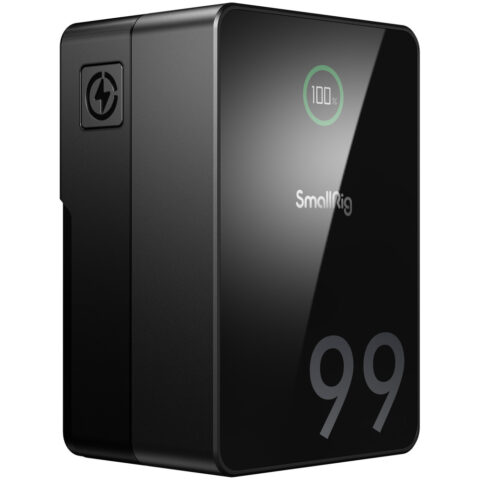 SmallRig
 4292 VB99 Pro Mini V Mount Battery
$314.95 incl. GST Ships in 1-2 business daysAdd to cart -
 SWIT
SWIT OMNI-99S Pocket V-Mount Lithium-Ion Battery
$279.95 incl. GST Ships in 1-2 business daysAdd to cart -
 Core SWX
 NANOX V98 Micro 98Wh Li-Ion Battery (V-Mount)
$483.95 incl. GST Ships in 1-2 business daysAdd to cart -
 SmallRig
 3579B VB50 mini V Mount Battery
$159.95 incl. GST Ships in 4-6 weeksAdd to cart
Plates, and a V mount battery for Sony FX3 rigs
A V-mount plate is the receiver the battery clicks into. Plates attach to a cage, a baseplate or 15 mm rods, and most have D-Tap outputs of their own. SmallRig's 4064B Compact V-Mount Battery Mounting System combines a V-mount plate, an Arca-Swiss quick-release plate and a stretchable baseplate, and SmallRig lists it for mirrorless bodies under 111 mm thick, including the FX3, a7 IV and a7S III. Browse all battery mounting plates for rod, cage and dual hot-swap designs.
There are two common ways to power a Sony body from a V-mount:
- USB-C PD into the camera. Sony's FX3 help guide covers powering the camera over USB-C from a PD source, so a pack or plate with USB-C PD can run it directly.
- A dummy battery. A D-Tap to NP-FZ100 dummy battery cable fits the camera's battery slot, and works on NP-FZ100 bodies such as the a7S III and a7 IV.
Mount the plate on the cage so the cable run is short. If you are choosing a cage first, our Sony camera cage guide lists which cage fits each body.
Plates and cables for Sony rigs
-
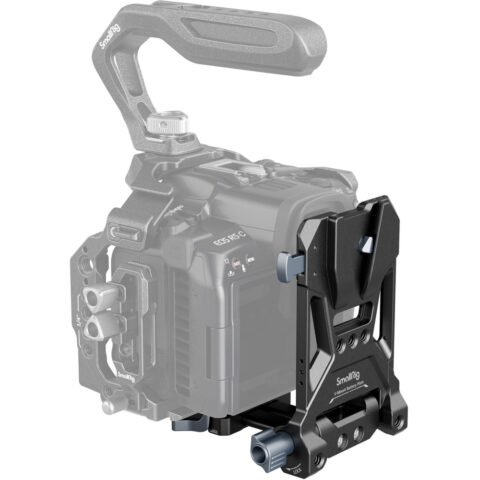 SmallRig
 4064B Compact V-Mount Battery Mounting System
$100.95 incl. GST Ships in 1-2 business daysAdd to cart -
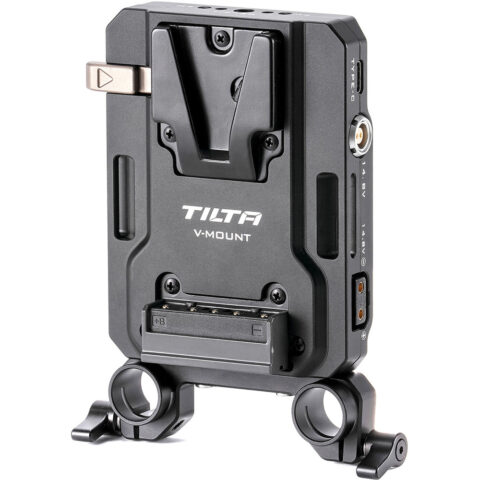 Tilta
Tilta Mini PD V-Mount Battery Plate (Black)
$162.95 incl. GST Ships in 1-2 business daysAdd to cart -
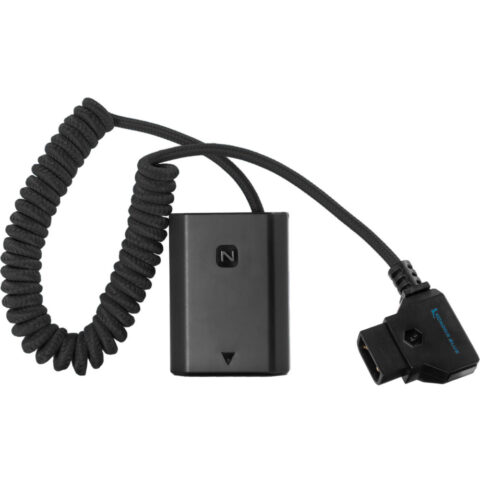 Kondor Blue
 D-Tap to NP-FZ100 Dummy Battery Cable for Sony a7S III/A7IV (Black)
$124.95 incl. GST Ships in 1-2 business daysAdd to cart -
 Kondor Blue
 D-Tap to USB-C Power Delivery Cable for Mirrorless Cameras (40cm, Raven Black)
$82.95 incl. GST Ships in 1-2 weeksAdd to cart
Mini vs full-size, and NP-F vs V mount
Mini V-mounts use the same plate and voltage as full-size packs in a smaller, lighter shell. They suit mirrorless rigs, gimbals and monitors. Full-size packs hold more energy and suit cinema cameras and lights, but most of them are over 100 Wh and need airline approval.
NP-F batteries are the smaller alternative. An NP-F970 is about 7.2 V and 6.6 Ah, which works out at roughly 47 Wh. That is half a 99 Wh V-mount in a much smaller package, and many monitors, including Atomos models, take NP-F directly.
| Battery type | Typical capacity | Listed weight | Suits |
|---|---|---|---|
| NP-F970 class | about 47 Wh | varies by brand | Monitors, small LEDs, audio gear |
| SmallRig VB50 mini | about 49 Wh | 0.34 kg | Gimbal rigs, light mirrorless setups |
| SWIT OMNI-99S | 99 Wh | 0.553 kg | Mirrorless rigs, travel |
| SmallRig VB99 Pro mini | about 99 Wh | about 644 g | Mirrorless rigs needing high USB-C output |
| SmallRig VB212 mini | about 212 Wh | 1.6 kg (package) | Studio days, lights; cannot fly |
Choose NP-F if you are powering a monitor or a small light and want low weight. Choose a mini V-mount when one battery should run the whole rig. For NP-F packs, browse the Sony NP-F range. For comparing a monitor that runs on NP-F, see our Atomos Ninja vs Shinobi guide. Chargers are in chargers and power supplies, and you can also browse the SWIT, Core SWX and Anton Bauer ranges.
Questions
Can I take a 99 Wh V-mount battery on a Qantas or Virgin Australia flight?
Yes, under both airlines' published rules, as long as it is a spare in your carry-on with the terminals protected. Batteries over 100 Wh and up to 160 Wh need airline approval before you fly, and anything over 160 Wh is not accepted as passenger baggage. Always check the airline's current page before travelling, especially on international routes.
How long will a 99 Wh battery run my camera?
Add up the watts of everything on the battery, then divide 99 by that figure and multiply by 0.8 to 0.9. A rig drawing 25 W gives roughly 3.2 to 3.6 hours. A camera on its own draws far less, so the monitor, transmitter and lights usually decide your runtime.
Is D-Tap safe for my monitor?
It is safe if the monitor accepts the full D-Tap voltage range, roughly 12 to 16.8 V. Check the input rating on the monitor or its power socket. If a device needs a fixed voltage, use a regulated D-Tap cable or its own battery. Never assume a D-Tap cable converts voltage unless it says so.
Do I need a special plate for a mini V-mount?
No. Mini V-mounts use the same V-mount interface, so they fit standard V-mount plates. Check that the plate's outputs suit your devices and that the plate position leaves room for the battery on your cage or rods.
Sources
Specifications and background were checked against these pages when the guide was last updated. Always confirm compatibility on the product page before ordering.
- casa.gov.au/packright/lithium-batteries
- casa.gov.au/packright/dangerous-good/rechargeable-lithium-ion-battery-spare-above-100-wh-not-exceeding-160-wh
- qantas.com/en-us/baggage/dangerous-goods/spare-batteries-and-powerbanks
- virginaustralia.com/au/en/travel-info/baggage/batteries
- smallrig.com/blog/v-mount-battery-guide.html
- smallrig.com/smallrig-VB99-Pro-mini-V-Mount-Battery-4292.html
- smallrig.com/SmallRig-CalebPike-VB212-mini-V-Mount-Battery-4293.html
- swit.cc/index.php?c=article&id=3108
- sony.com/electronics/support/camcorders-and-video-cameras-interchangeable-lens-camcorders/ilme-fx3/specifications
- smallrig.com/smallrig-Compact-V-Mount-Battery-Mounting-System-4064B.html