Buying guide
Pelican Case Sizes: Interior Dimensions and Nanuk Equivalents
Interior dimensions for popular Pelican cases, which sizes fit Australian carry-on limits, how Air differs from Protector, how to choose foam or dividers, and Nanuk equivalents compared.
Short answer Choose a Pelican case by its interior dimensions, not its model number. The 1400 and 1450 suit a body and a couple of small lenses, the 1510 and 1535 Air are the carry-on sizes, and the 1560, 1600 and 1615 Air are for larger kits that travel as checked luggage. If you prefer Nanuk, the 935 is the closest carry-on alternative.
Pelican case sizes are confusing because the four-digit numbers only hint at size. A 1520 is not much bigger than a 1500, and an Air case with a similar number can have a very different shape. This guide lists the interior dimensions Pelican publishes, explains which sizes work as carry-on in Australia, and compares Air, Protector and Nanuk so you can pick one case and get on with packing.
Pelican case sizes at a glance
The table below uses Pelican's own interior figures. Where Pelican only lists inches, we have converted to centimetres and rounded, so treat the last digit as approximate. Depth is the total of lid and base together, and foam or dividers will take some of it.
| Model | Range | Interior L x W x D (cm) | Typical use |
|---|---|---|---|
| 1400 | Protector | 30.0 x 22.5 x 13.2 | Compact body, flash, audio recorder |
| 1450 | Protector | 37.3 x 25.9 x 15.5 | Small mirrorless kit, wireless mics |
| 1485 Air | Air | 45.2 x 25.9 x 15.7 | Slim hand-carry kit |
| 1500 | Protector | 42.7 x 28.4 x 15.5 | Body plus two or three lenses |
| 1520 | Protector | 46.0 x 32.8 x 17.0 | Mid-size kit, small lights |
| 1550 | Protector | 47.2 x 36.1 x 19.6 | Deeper mid-size kit, drones |
| 1510 | Protector | 50.2 x 27.9 x 19.3 | Wheeled carry-on |
| 1535 Air | Air | 51.8 x 28.4 x 18.3 | Lighter wheeled carry-on |
| 1560 | Protector | 50.5 x 38.1 x 22.9 | Wheeled, larger photo or video kit |
| 1600 | Protector | 54.6 x 41.9 x 20.3 | Wide kit, monitors, lighting |
| 1610 | Protector | 55.4 x 42.4 x 26.9 | Deep wheeled kit, cinema bodies |
| 1615 Air | Air | 75.2 x 39.4 x 23.8 | Long checked case, sliders, stands |
| 1637 Air | Air | 59.4 x 44.7 x 33.8 | Very deep wheeled case |
To use the table, lay your kit out on the floor in the arrangement you want, measure the outside edges, and allow a few centimetres of padding around the perimeter. Then find the smallest case whose interior clears those numbers, including depth. The tallest item, usually a lens hood, a camera with a grip, or a gimbal, decides the depth you need.
Pelican sizes from small to large
-
 Pelican
 1400 Case (Black, with Foam)
$318.95 incl. GST Ships in 1-2 business daysAdd to cart -
 Pelican
 1450 Case (Black, With Foam)
$271.95 incl. GST Ships in 2-3 business daysAdd to cart -
 Pelican
 1500 Case (Black, With Foam)
$473.95 incl. GST Ships in 1-2 business daysAdd to cart -
 Pelican
 1560 Case (Black)
$467.95 incl. GST Ships in 2-3 business daysAdd to cart
How the ladder steps up
- Small (1400, 1450): handheld cases for a single body, a lav mic kit, drives and cards. The 1400 weighs 1.8 kg empty according to Pelican.
- Medium (1500, 1520, 1550): the step where a full working stills kit fits. The 1550 adds depth, which matters for drones and taller lenses.
- Carry-on (1510, 1535 Air): wheeled cases built around airline overhead limits.
- Large (1560, 1600, 1610): for video kits with a monitor, batteries and a light or two. These are checked-luggage or vehicle cases.
- Long (1615 Air, 1650): for tripods, sliders and light stands, or a whole shoot packed in one box.
Carry-on camera case in Australia: Pelican 1510 vs 1535
Qantas, Virgin Australia and Jetstar all publish a standard overhead bag size of 56 x 36 x 23 cm for domestic economy. Pelican lists the 1510 exterior at 55.9 x 35.1 x 22.9 cm and the 1535 Air at 55.8 x 35.5 x 22.8 cm, so both sit just inside that box. Pelican itself adds a note to check with your airline, and that is good advice because the case has no margin to spare.
Weight is where the two differ. Pelican lists the 1510 at 5.4 kg empty and 6.2 kg with foam, and the 1535 Air at 3.9 kg empty and 4.5 kg with foam. Airline weight limits vary by carrier and fare, and some allowances are 7 or 8 kg in total, so a heavy case can use most of your allowance before you pack a camera. Check your airline's current rules before you fly.
| Pelican 1510 | Pelican 1535 Air | Nanuk 935 | |
|---|---|---|---|
| Interior (cm) | 50.2 x 27.9 x 19.3 | 51.8 x 28.4 x 18.3 | 52.1 x 28.7 x 19.1 |
| Exterior (cm) | 55.9 x 35.1 x 22.9 | 55.8 x 35.5 x 22.8 | 55.9 x 35.6 x 22.9 |
| Empty weight | 5.4 kg | 3.9 kg | 5.3 kg |
| Family | Protector | Air (HPX2 polymer) | Nanuk (NK-7 resin) |
So which one? The 1535 Air suits anyone who flies often or boards small aircraft, because the weight saving goes straight into your allowance. The 1510 is the heavier, more traditional Protector build with a slightly deeper interior. Both are wheeled with a retractable handle.
Batteries matter too. CASA guidance says spare lithium batteries must travel in carry-on, with the terminals protected. Batteries up to 100 Wh are generally allowed without approval, those over 100 Wh and up to 160 Wh need airline approval, and anything larger cannot go in passenger baggage. If you run V-mount packs, our V-mount batteries guide covers watt-hour ratings in more detail.
Carry-on cases mentioned in this guide
-
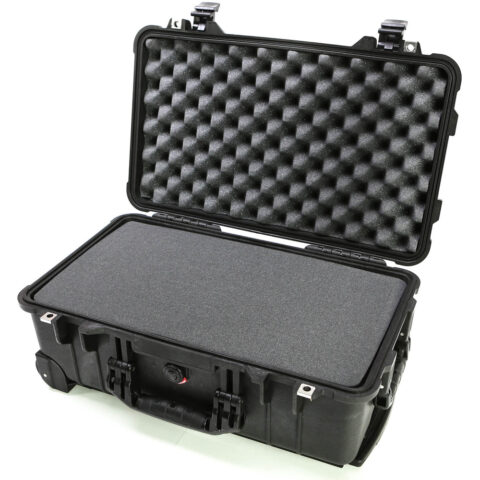 Pelican
 1510 Carry-On Case with Foam Set (Black)
$657.95 incl. GST Ships in 1-2 business daysAdd to cart -
 Pelican
 1535AirWF Wheeled Carry-On Hard Case with Foam Insert (Black)
$466.95 incl. GST Ships in 1-2 business daysAdd to cart -
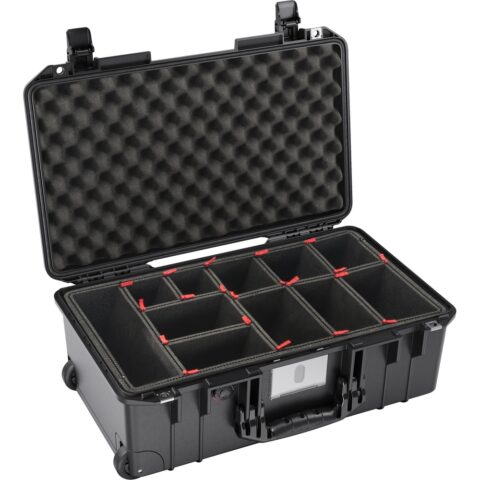 Pelican
 1535Air Wheeled Carry-On Hard Case with TrekPak Divider Insert (Black, 27L)
$660.95 incl. GST On backorder, dispatch date to be confirmedAdd to cart -
 Nanuk
Nanuk 935 Wheeled Hard Case (Black, With Foam, 28.5L)
$851.95 incl. GST Ships in 1-2 business daysAdd to cart
Pelican Air vs Protector
Pelican makes both families to the same basic brief: waterproof, crushproof and dustproof, with an automatic pressure equalisation valve so the lid still opens after a flight. The differences are in the shell and latches.
- Material: Air cases use Pelican's HPX2 polymer. Protector cases use polypropylene.
- Weight: Pelican says Air cases are up to 40 percent lighter. That is a maximum, not a figure for every size, but the 1535 Air against the 1510 above shows the kind of saving you can expect.
- Latches: Air cases have Press and Pull latches. Protector cases use double-throw latches.
- Sealing: both are listed as IP67. Pelican's catalogue describes watertight performance to 1 metre for 30 minutes when the case is closed properly with an undamaged O-ring.
Air and Protector sizes do not map one to one. The 1615 Air, for example, is a long case that has no direct Protector twin, so compare interiors rather than assuming a similar number means a similar shape. Protector cases suit rough handling where weight is not a concern, such as vehicle kits or site work. Air cases suit travel.
Interiors: foam, dividers and TrekPak
Most Pelican cases are sold in several interior versions. The model suffix tells you which: WF means with foam, NF means no foam, and TP means TrekPak. Pelican lists the 1510 in four versions: 1510WF, 1510NF, 1514 with padded dividers, and 1510TP.
Pick N Pluck foam
Pre-scored foam cubes that you pull out to make a cavity for each item. It gives a close, shock-absorbing fit, but once you pluck it you cannot put it back. It suits a kit that rarely changes. Replacement foam sets such as the Pelican 1511 foam set let you start over.
Padded dividers
Padded walls that attach inside the case and can be moved to form compartments. Quicker to change than foam, though the fit is looser. A good choice if you swap lenses and bodies between jobs.
TrekPak
Pelican's TrekPak system uses divider walls that you cut to length and join with the supplied fasteners, so you get fixed compartments that can still be rebuilt later. It is sold fitted in some cases and as a kit for others, such as the TrekPak kit for the 1535 Air. Add a lid organiser if you carry cables, cards and paperwork. Kits, locks, straps and spare valves are in hard case accessories.
Interiors and larger cases
-
 Pelican
 TrekPak Divider Kit for 1535 Air Case
$366.95 incl. GST Ships in 2-3 business daysAdd to cart -
 Pelican
 Padded Divider Set for 1560 Cases
$463.95 incl. GST Ships in 8-12 weeksAdd to cart -
 Pelican
 1511 Four Piece Replacement Foam Set
$153.95 incl. GST Ships in 1-2 business daysAdd to cart -
 Pelican
 1615 Air Case (Black, With Foam)
$617.95 incl. GST Ships in 1-2 business daysAdd to cart
Pelican vs Nanuk: equivalent sizes
Nanuk builds its cases from NK-7 resin and uses PowerClaw latches, which clamp the lid against the seal and have an integrated slide lock to stop them opening by accident. Nanuk lists its cases as IP6X dustproof and IPX7 waterproof to 1 metre for 30 minutes, and backs them with a limited lifetime warranty. Both are sealed to similar ratings, so the choice usually comes down to the exact interior size, the latch style you prefer and what is in stock.
The pairs below are our comparison of the published interiors, not manufacturer equivalents. All figures are from Pelican and Nanuk.
| Nanuk | Interior (cm) | Weight | Closest Pelican | Pelican interior (cm) |
|---|---|---|---|---|
| 910 (8.2 L) | 33.6 x 23.4 x 10.4 | 1.4 kg | 1400 | 30.0 x 22.5 x 13.2 |
| 925 (21 L) | 43.2 x 30.0 x 16.3 | 2.8 kg | 1500 | 42.7 x 28.4 x 15.5 |
| 930 (26.5 L) | 45.7 x 33.0 x 17.5 | 3.2 kg | 1520 | 46.0 x 32.8 x 17.0 |
| 935 (28.5 L) | 52.1 x 28.7 x 19.1 | 5.3 kg | 1510 or 1535 Air | 50.2 x 27.9 x 19.3 |
| 950 (51.9 L) | 52.1 x 38.9 x 25.7 | 6.8 kg | 1560 | 50.5 x 38.1 x 22.9 |
Nanuk describes the 925, 930 and 935 as airline carry-on cases. The 935 is wheeled and is the one to compare with the 1510 and 1535 Air. The 950 is a deeper alternative to the 1560, with Pelican listing the 1560 at 7.7 kg empty. You can browse the full range of Pelican cases and Nanuk models together in our waterproof cases category.
Questions
Is the Pelican 1510 a carry-on case in Australia?
Its exterior of 55.9 x 35.1 x 22.9 cm sits inside the 56 x 36 x 23 cm overhead size published by Qantas, Virgin Australia and Jetstar. Weight is the catch: it is 5.4 kg empty, and some fares allow only 7 or 8 kg in total. Check your airline's current allowance before you pack.
What is the difference between the Pelican 1510 and 1535 Air?
They share almost the same outside size. The 1535 Air has a slightly longer, shallower interior and weighs 3.9 kg empty against 5.4 kg for the 1510. The 1535 Air uses HPX2 polymer and Press and Pull latches; the 1510 uses polypropylene and double-throw latches.
Do Pelican cases need the valve opened after a flight?
No. Current Pelican Air and Protector cases have an automatic pressure equalisation valve that balances the air pressure inside the case while keeping water out. That stops the lid from locking shut after a change in altitude. Keep the valve clear of tape and stickers so it can work.
Should I choose foam, padded dividers or TrekPak?
Choose foam for a fixed kit that needs a snug fit, padded dividers if you change lenses and bodies often, and TrekPak if you want firm compartments that you can still rebuild. Dividers and TrekPak can be rearranged as your kit changes, while plucked foam is usually replaced.
Is Nanuk a good alternative to Pelican?
Nanuk cases carry IP6X and IPX7 ratings, a limited lifetime warranty and PowerClaw latches with slide locks, so they are built to a similar standard. Compare interior dimensions first, because the sizes rarely match exactly. The Nanuk 935 is the closest carry-on alternative to the Pelican 1510 and 1535 Air.
Sources
Specifications and background were checked against these pages when the guide was last updated. Always confirm compatibility on the product page before ordering.
- pid.pelican.com/ca/en/products/cases/protector-cases?config=1&
- pid.pelican.com/ca/en/products/cases/air-cases?config=1&
- pid.pelican.com/ca/en/product/cases/protector/1510
- pid.pelican.com/ca/en/product/cases/air/1535
- pid.pelican.com/ca/en/product/cases/protector/1400
- casa.gov.au/packright/lithium-batteries
- media.pelican.com/docs/catalogs/pelican-cases-catalog-2025.pdf
- nanuk.com/products/nanuk-935
- nanuk.com/products/nanuk-930
- luggagedirect.com.au/blogs/blog/the-carry-on-maths-australia-2026-what-actually-fits-on-qantas-virgin-australia-and-jetstar