Buying guide
Lighting for YouTube Videos: Key, Fill and Back Light
Where to place key, fill and back lights, what to buy for a small bedroom or a larger room, how COB, panel and tube lights differ, and which colour specifications matter.
Short answer Good lighting for YouTube videos starts with one soft key light placed about 30 to 45 degrees to the side of the camera and a little above eye level. Add a fill light or white reflector on the other side to control shadows, and a small back light behind you for separation. In a small room, a 60 to 100 watt COB light in a 60 to 90 cm softbox is enough.
Most YouTube lighting problems come from a single light in the wrong place, not from a lack of power. A flat, bright face with no shape looks cheap, and a dim room pushed up in the edit looks noisy. The fix is a simple three-light layout, lights with accurate colour, and a modifier big enough to soften the key. This guide covers where to put each light, what to buy for your room size, and how to read the specifications that matter.
Three point lighting for YouTube videos
Three point lighting uses three roles. You do not always need three separate fixtures, but you do need to think about all three jobs.
Key light
The key is your main light. Start with it about 30 to 45 degrees to one side of the camera, slightly above eye level and angled down towards your face. Moving it towards the camera gives flatter, more even light. Moving it further round to the side gives more shape and shadow. In a small room the key is often only 0.6 to 1.5 metres from your face.
Fill light
The fill sits on the opposite side of the camera, closer to the lens axis and at a lower level of brightness. Its job is to lift the shadows the key creates, not to remove them. In a small room a white wall or a reflector often does the job without a second light.
Back light
The back light, also called a rim or hair light, sits behind you and above, on the side opposite the key. It draws a thin bright edge along your hair and shoulders so you do not merge into the background. Keep it subtle, and use a grid or barn doors if it flares into the lens.
Key to fill ratio
The ratio compares the light falling on the bright side of your face with the shadow side.
| Ratio | Look | Suits |
|---|---|---|
| 1:1 | Flat and even | Beauty, bright tutorial content |
| 2:1 | Mild shape, natural | Most talking-head videos, product reviews |
| 4:1 | Noticeable shadow | Commentary, interviews with more mood |
| 8:1 or more | Strong contrast | Cinematic segments, not everyday presenting |
For most channels, somewhere between 2:1 and 4:1 works. Start near 2:1 and add contrast if the image looks flat.
Choosing lights by room size
The size of your room decides how big a modifier you can fit, how far the key can sit from you, and how much light bounces off the walls.
Small bedroom or home office
A compact COB light in the 60 to 100 watt class with a 60 to 90 cm softbox gives a soft key without taking over the room. Put the key close and to the side, use a pale wall or reflector as fill, and move yourself away from the back wall if you can. A slim tube light or a small panel can act as the back light where there is no room for a stand. A grid on the softbox helps stop light spilling onto nearby walls.
Larger room or small studio
More space lets you move further from the background, use a bigger softbox and add separate background lights. A 150 to 300 watt COB light with a 90 to 120 cm softbox is a common key in this situation. Flags and grids become more useful because there is space to shape the light.
Ceiling height and distance
Light falls off quickly with distance. Double the distance and you get roughly a quarter of the light. Moving the key closer makes it brighter and softer, and lets the background fall darker, which helps separation. In a room with a low ceiling, a tube standing upright behind you is often easier than a high back light on a boom.
Key lights mentioned in this guide
-
 Godox
Godox SL60IIBI Bi-Colour LED Video Light
$259.95 incl. GST On backorder, dispatch date to be confirmedAdd to cart -
 Godox
Godox ML60IIBi Bi-Colour LED Monolight
$299.95 incl. GST Ships in 3-5 business daysAdd to cart -
 Aputure
amaran COB 200d S Daylight LED Monolight
$418.95 incl. GST Ships in 3-4 weeksAdd to cart -
 SmallRig
 4376B RC 60B COB LED Video Light
$279.95 incl. GST Ships in 4-6 weeksAdd to cart
LED light for video: COB vs panel vs tube
Nearly every current video light is LED, but the shape of the fixture changes how you use it. You can browse all three types in our continuous lighting range.
| Type | Strengths | Limits | Main role |
|---|---|---|---|
| COB monolight | High output from a small source, takes softboxes, lanterns and grids | Needs a modifier to look soft, some models have fan noise | Key light |
| LED panel | Thin, light, broad output, easy to place close | Less punch through a large softbox, harder to control spill | Fill, small-room key, desk setups |
| Tube light | Slim, hides easily, good for edges and background colour | Lower output, hard to use as a soft key | Back light, background accents |
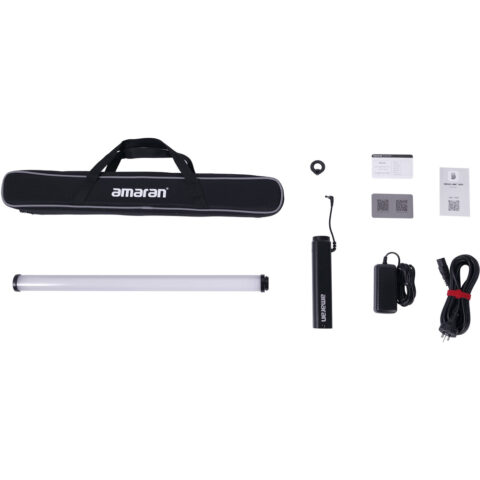
Examples from the range: the Godox SL60IIBi is a 75 watt bi-colour COB light with a Bowens mount, so it takes standard softboxes. The amaran COB 200d S is a 200 watt daylight COB, also Bowens mount, suited to larger rooms or bigger softboxes. The Godox ML60IIBi is a compact bi-colour light with a Godox mount that accepts Bowens modifiers through an adapter, and it can run from an NP-F970 or V-mount battery as well as mains. For panels and tubes, the amaran Ace 25c is a small panel with a built-in battery, and the amaran T2c is a tube that runs from a detachable battery grip.
Softbox vs ring light
A ring light sits around the lens, which puts it in the flattest possible position. That suits beauty content and close-up makeup work, and it leaves a ring-shaped reflection in the eyes. For a presenter who wants some shape to the face, a softbox off to one side gives a more natural look. Many creators use both: a softbox as key and a small ring or panel as fill.
Colour temperature, CRI and TLCI
Colour temperature
Colour temperature is measured in kelvin. Around 5600K matches daylight and around 3200K matches warm tungsten bulbs. Daylight-only lights such as the 200d S are fixed at 5600K. Bi-colour lights such as the SL60IIBi, which Godox lists at 2800K to 6500K, let you match a window or warm room lamps. The rule is simple: set every light in the shot to the same colour temperature, then set your camera white balance to match. Mixing a daylight window with warm ceiling lights leaves your face two colours.
CRI and TLCI
CRI, the Colour Rendering Index, measures how accurately a light shows a set of colour samples compared with a reference source. TLCI, the Television Lighting Consistency Index from the European Broadcasting Union, models how a camera and display see the light, which makes it more relevant for video. For faces and products, look for CRI and TLCI of 95 or higher. Godox lists the SL60IIBi at CRI 96 or more and TLCI 97 or more, and Aputure lists the amaran 200d S at CRI 96+ and TLCI 99+.
RGB lights add coloured effects for backgrounds, which is useful for gaming and music channels. For the key light on your face, accurate white matters more than colour effects.
Modifiers that make the difference
A bare COB light is a small, hard source. Put it in a softbox and it becomes a large, soft one. The larger the softbox appears from your position, the softer the light. See our softbox and modifier guide for sizes and shapes in detail.
- Softbox, 60 to 90 cm: the standard key for a seated presenter in a small room.
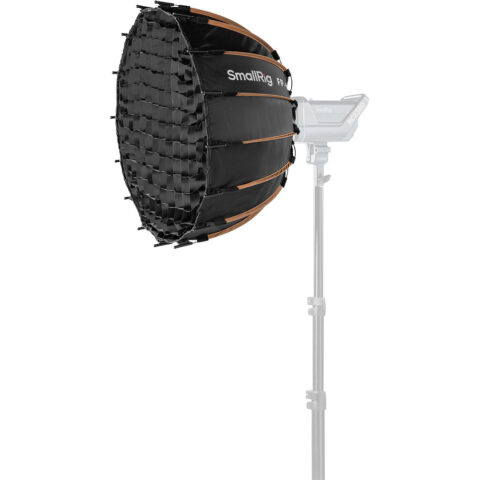
- Parabolic softbox: deeper shape, a little more direction. The SmallRig FP-60 and FP-90 are Bowens mount and come with a honeycomb grid.
- Lantern: spreads light in all directions, good for soft overall fill or a two-person podcast. Aputure's Lantern 90 is 90 cm across with a Bowens mount.
- Grid: fabric egg crate that stops the softbox spilling onto walls and the background.
Check the mount before you buy. Bowens is the common standard for COB lights, but some compact lights use smaller or proprietary mounts. Our Aputure, amaran, Godox and Nanlite comparison covers which brands use which. Stands and clamps are in light stands and mounting.
Softboxes and lanterns for a key light
-
 Godox
Godox QR-P90T Quick Release Softbox with Bowens Mount (35.4")
$163.95 incl. GST Ships in 3-5 business daysAdd to cart -
 SmallRig
 5396 FP-60 Quick-Setup Folding Parabolic Softbox
$162.95 incl. GST Ships in 4-6 weeksAdd to cart -
 Aputure
 Lantern 90 Softbox
$243.95 incl. GST Ships in 1-2 business daysAdd to cart
Three example setups
- Desk or streaming setup: one small panel as a key light for streaming, placed beside the monitor at eye level, plus a white wall as fill. Add a tube behind you for colour on the background.
- Bedroom talking head: a 60 to 100 watt bi-colour COB in a 60 to 90 cm softbox as key, a reflector or small panel as fill, and a tube as back light.
- Larger room, two people: a 200 watt class COB in a 90 to 120 cm softbox or a lantern over the table, with tubes or small panels for separation and background.
Fill, back and desk lights
-
 Aputure
amaran T2c RGBWW LED Tube Light with Battery Grip (60cm)
$352.95 incl. GST Ships in 1-2 business daysAdd to cart -
 NanLite
Nanlite PavoTube II 15C RGB LED Tube Light (60cm, 2-Light Kit)
$395.95 incl. GST Ships in 1-2 business daysAdd to cart -
 Aputure
amaran Ace 25c RGB LED Light Panel (Charcoal)
$173.95 incl. GST Ships in 1-2 business daysAdd to cart -
 Ulanzi
 K20 Bi-Colour LED Key Light Panel
$84.95 incl. GST Ships in 1-2 business daysAdd to cart
If you are building a full home studio, our podcast setup at home guide covers sound, which matters as much as light.
Questions
How many lights do I need for YouTube?
One good key light in a softbox makes the biggest difference. A reflector or pale wall can act as fill, so two lights plus a reflector covers most talking-head videos. Add a small tube or panel behind you when you want separation from the background. Buy the key first and add the others as your channel grows.
What is a good key light for streaming?
For a desk stream, a small bi-colour panel placed beside the monitor at eye level works well because it fits the space and lights your face evenly. If you have room for a stand, a compact COB light in a 60 cm softbox gives softer light with more shape. Check CRI and TLCI are 95 or higher.
Should I buy daylight or bi-colour lights?
Daylight lights are fixed near 5600K, which is simple when you only ever film under daylight or with the curtains closed. Bi-colour lights adjust across a range, such as 2800K to 6500K on the Godox SL60IIBi, so you can match a window or warm room lights. If you film at different times of day or in mixed light, bi-colour is more flexible.
How far should my key light be from my face?
In a small room, 0.6 to 1.5 metres is a common starting point. Closer gives softer light and a darker background, while further away gives more even light but less softness. A useful rule is to start with the softbox roughly as far from you as it is wide, then adjust by eye on the camera monitor.
Is a ring light enough for YouTube?
A ring light gives flat, even light and suits beauty and makeup videos. For most other content it looks a little flat because it sits on the lens axis. A softbox placed to one side gives more shape. A ring light works well as a fill light alongside a softbox key.
Sources
Specifications and background were checked against these pages when the guide was last updated. Always confirm compatibility on the product page before ordering.
- godox.com/product-a/SL60II.html
- godox.com/product-b/ML60IIBi.html
- aputure.com/EN-US/products/amaran-200d-s?Title=Default+Title
- tech.ebu.ch/tlci-2012
- aputure.com/products/lantern-90
- smallrig.com/Quick-Setup-Folding-Parabolic-Softbox.html
- help.aputure.com/en/amaran-ace-25c/photometrics-technical-specifications
- help.aputure.com/en/amaran-pixel-tubes/general-faq