Buying guide
Softbox Size Guide: Shapes, Grids and Mounts Explained
How softbox size and distance control softness, when to choose an octabox, strip box, lantern or parabolic, what grids and diffusion do, and how Bowens and proprietary mounts affect fit.
Short answer Softness depends on how large the modifier looks from your subject, so size and distance matter more than brand. As a starting point, use a 60 to 90 cm softbox for a seated presenter or head-and-shoulders portrait, 120 to 150 cm for groups and full-length shots, and place it roughly as far from the subject as it is wide. Then check the mount matches your light.
This softbox size guide explains how modifier size and distance shape the light, how octaboxes, strip boxes, lanterns and parabolic softboxes differ, when to add a grid, and how Bowens and proprietary mounts affect what fits. It finishes with starting points for matching a modifier to your light's output.
Softbox size guide: how size and distance control softness
A light looks soft when its glowing surface is large compared with the subject. Shadows get gentle edges, skin looks smoother and catchlights in the eyes get bigger. The key word is apparent size, meaning how big the modifier looks from the subject's position.
- A 90 cm softbox 90 cm from a face looks large and gives soft light.
- The same softbox 3 metres away looks small and gives harder light.
- A small softbox close in can be softer than a big one far away.
A practical rule of thumb is to start with the modifier about as far from the subject as its diameter or longest side: a 60 cm box at about 60 cm, a 90 cm box at about 90 cm, and a 150 cm box at about 1.5 metres. It is a starting point, not a law.
Distance also changes brightness and falloff
Light from a small source follows the inverse square law. Double the distance and the subject gets roughly a quarter of the light. A softbox is not a point source, but the practical effect holds: close placement gives soft light that falls off quickly towards the background, while a more distant placement gives more even light across a scene with less softness.
| Modifier size | Typical use | Notes |
|---|---|---|
| 30 to 50 cm | Desk streaming, small products, on-camera fill | Needs to be very close to look soft |
| 60 to 70 cm | Head-and-shoulders, YouTube key in a small room | Easy to fit in a bedroom or office |
| 90 cm | Portraits, interviews, seated presenters | A flexible first softbox |
| 120 cm | Half-length portraits, two people, larger rooms | Needs a sturdy stand and more output |
| 150 cm and up | Full-length, groups, broad soft key in a studio | Suits high-output lights |
Shapes: octabox vs softbox, strip, lantern and parabolic
| Shape | Character | Common uses |
|---|---|---|
| Octabox | Round catchlights, even, natural modelling | Portraits, interviews, general key light |
| Rectangular softbox | Broad, window-like source that can stand upright or lie flat | Full-length portraits, products, window light |
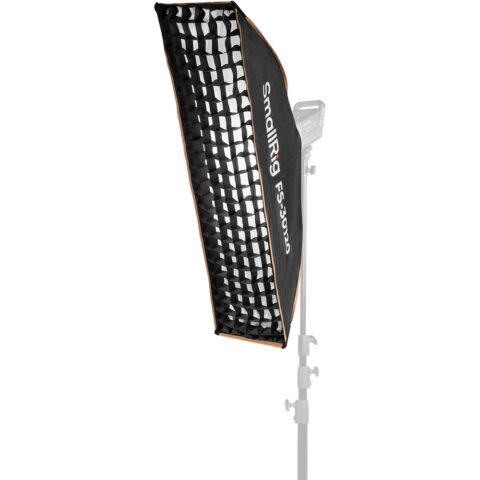
| Strip box | Long and narrow, limited sideways spread | Rim and hair light, edge light on products |
| Lantern | Spreads light in nearly all directions | Overhead fill, podcasts, room ambience |
| Deep parabolic | Recessed front, more forward direction | Controlled portrait key, fashion |
Octabox vs softbox
The difference is mostly shape, not softness. A 120 cm octabox and a 120 cm rectangular box at the same distance give similar softness. Octaboxes give round catchlights that look natural in eyes. Rectangles are handy when the subject is tall or you want a window effect.
Lantern softbox
A lantern softbox is a round diffuser that throws light outwards in every direction. It brightens walls and ceilings as well as the subject, which is good for a soft, natural room feel and less good when you want a dark background. Many lanterns come with a skirt to block one side. Aputure's Lantern 90, for example, is 90 cm across, Bowens mount, with 1-stop diffusion and a removable hook-and-loop skirt.
Parabolic softboxes
Deep parabolic boxes push light forward more than shallow ones. With both diffusion layers fitted they stay soft; with the front removed they give a punchier, more contrasty look. The SmallRig FP-60 and FP-90 are folding parabolic boxes with a Bowens mount, dual-layer diffusion and a honeycomb grid included. Godox's QR-P series covers parabolic sizes from 60 to 150 cm.
Softboxes mentioned in this guide
-
 Godox
Godox QR-P90T Quick Release Softbox with Bowens Mount (35.4")
$163.95 incl. GST Ships in 3-5 business daysAdd to cart -
 SmallRig
 5395 FP-90 Quick-Setup Folding Parabolic Softbox
$211.95 incl. GST Ships in 4-6 weeksAdd to cart -
 Godox
Godox EazyFlow Octa 120 Foldable Softbox (120cm)
$139.95 incl. GST Ships in 4-6 weeksAdd to cart -
 Aputure
 Light Dome 150 Softbox
$527.95 incl. GST Ships in 1-2 business daysAdd to cart
Grids and diffusion layers
Grid for softbox
A fabric grid, or egg crate, fits across the front of a softbox and stops light leaving at wide angles. It keeps light off the background and walls and away from the camera lens, which improves separation. A grid does not shrink the glowing surface, so the light stays soft on the subject, but you lose some wraparound. Common grid angles are 40 and 45 degrees. Aputure's 90 cm Light Dome III came with a 40 degree grid, and its Light Dome 150 comes with a 45 degree grid.
Grids are usually made for a specific softbox, so buy the matching one, such as the Godox grid for the QR-P90. More are listed under barndoors, snoots and grids.
Inner baffle and front diffusion
Most softboxes have an inner baffle that spreads the light before it reaches the front panel, and an outer diffusion panel that becomes the visible source. More layers give a more even front with fewer hotspots but cost some output. Manufacturers often rate diffusion in stops of light lost: the Light Dome 150 includes 1.5 stop and 2.5 stop front fabrics. With a low-output light, use lighter diffusion. With plenty of output, heavier diffusion gives a smoother result.
Bowens mount softbox or proprietary mount
The mount on the back of the softbox, called the speed ring, must match your light.
- Bowens S-type: the most common mount on COB video lights and many studio flashes. A Bowens mount softbox from one brand will usually fit a Bowens light from another. The Light Dome 150, Lantern 90, SmallRig FP series and Godox QR-P boxes we carry are all Bowens mount.
- Interchangeable speed rings: Godox's EazyFlow softboxes ship with a Bowens ring, and Godox offers optional rings for its own, Profoto, Broncolor and other systems.
- Mini Bowens and Mini ProLock: smaller mounts on compact lights. Full-size Bowens softboxes need an adapter, such as the Aputure Mini ProLock to Bowens adapter for the STORM 80c.
- Nanlite FM mount: used on the Forza 60B II, which Nanlite supplies with a Bowens adapter in its US kit.
- Panel-specific softboxes: LED panels and tubes usually take softboxes made for that exact model rather than a universal mount.
Weight matters too. A large softbox on a small light can overload the mount, so pair big modifiers with lights and stands built for them. Our comparison of Aputure, amaran, Godox and Nanlite lists which mount each light uses.
Lanterns and strip boxes
-
 Aputure
 Lantern 90 Softbox
$243.95 incl. GST Ships in 1-2 business daysAdd to cart -
 Godox
Godox CS-85T Lantern Softbox with Bowens Mount (33.5")
$129.95 incl. GST Ships in 3-5 business daysAdd to cart -
 Godox
Godox SB-FW 30x120cm Grid Softbox (Bowens Mount)
$91.95 incl. GST Ships in 3-5 business daysAdd to cart -
 SmallRig
 5370 FS-30120 Quick-Setup Folding Strip Softbox
$124.95 incl. GST Ships in 4-6 weeksAdd to cart
Matching the modifier to your light output
Every layer of diffusion and every extra centimetre of distance costs light, so a bigger softbox needs a brighter light to reach the same exposure. These are starting points for a single COB light indoors:
| Light output | Softbox that pairs well | Example lights we carry |
|---|---|---|
| Around 60 to 80 W | 45 to 90 cm, one diffusion layer if output is tight | Godox SL60IIBi, Nanlite Forza 60B II |
| Around 150 to 300 W | 90 to 120 cm octa or parabolic | amaran COB 200d S |
| 400 W and above | 120 to 150 cm, lanterns for large spaces | Aputure STORM 400x |
Aputure says the Light Dome 150 works especially well with the output of its LS 600 series, which shows the kind of light a 150 cm box is designed around. For placement advice, read our lighting for YouTube videos guide, and browse all light modifiers or the softboxes category.
Questions
What size softbox do I need for YouTube?
For one person seated at a desk or in a small room, a 60 to 90 cm softbox is the usual choice. It is large enough to look soft at about arm's length and small enough to fit. Pair it with a light of around 60 to 100 watts. Go larger only if you have the room and output.
Is an octabox better than a rectangular softbox?
Neither is softer at the same size and distance. An octabox gives round catchlights and suits portraits and interviews. A rectangular box can stand upright for full-length shots or mimic a window, and a strip box is useful as a rim light. Choose by the shape of catchlight and coverage you want.
Do I need a grid on my softbox?
Add a grid when light is spilling onto the background, walls or into the lens, or when you want a darker background behind the subject. It keeps the light soft on the subject while narrowing where it goes. In a small white room a grid is often the easiest way to improve contrast and separation.
Will any Bowens mount softbox fit my light?
A Bowens mount softbox will fit a light with a full-size Bowens mount. Lights with Mini Bowens, Mini ProLock, Godox mount or Nanlite FM mount need a matching modifier or an adapter. Also check that the light and stand can support the weight of a large softbox.
Sources
Specifications and background were checked against these pages when the guide was last updated. Always confirm compatibility on the product page before ordering.
- aputure.com/products/light-dome-150
- aputure.com/products/lantern-90
- smallrig.com/Quick-Setup-Folding-Parabolic-Softbox.html
- godox.com/product-e/EazyFlow.html
- godox.com/product-d/QR-Series.html
- aputure.com/EN-US/products/storm-80c
- nanliteus.com/products/forza-60b-ii-bi-color-led-spotlight
- aputure.com/products/light-dome-iii