Eventide
2 products. Prices from $444.95 to $531.95, including GST.
Eventide was founded in 1971 and is headquartered in Little Ferry, New Jersey. It makes digital effects processors, DSP software, guitar pedals and broadcast delays. From Eventide we stock the PowerMax V2 isolated pedalboard power supply and the Knife Drop fuzz octave pedal made with Third Man Hardware. They suit guitarists and bassists building or powering a pedalboard.
Showing all 2 results
-
 Eventide
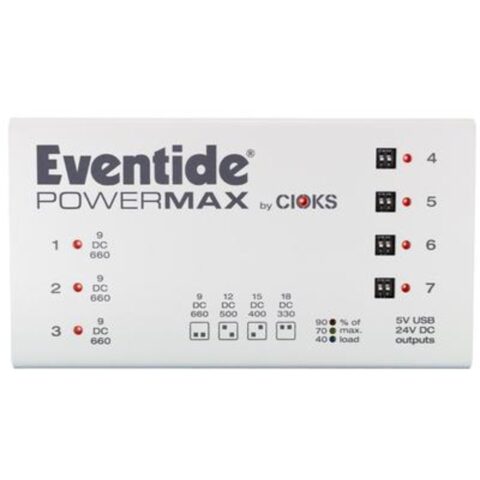
 PowerMax V2
$444.95 incl. GST On backorder, dispatch date to be confirmedAdd to cart -
 Eventide
 Knife Drop Fuzz Octave Pedal
$531.95 incl. GST Ships in 1-2 weeksAdd to cart
Shop Eventide by category
About Eventide
Eventide lists the PowerMax with seven isolated outlets: three at 9 volts and 660mA, and four switchable between 9, 12, 15 and 18 volts at up to 660mA, plus a 24 volt auxiliary outlet and a 1A USB port. It accepts 90 to 265 volt mains input, so it works on Australian power, and measures 160 x 88 x 25.4mm. The Knife Drop is an octave fuzz and analogue synth pedal made with Third Man Hardware, with presets developed with Jack White.
Isolated outlets stop pedals interacting through a shared ground, which cuts hum and noise, especially with digital pedals on the same board. Check each pedal's voltage, polarity and current draw, and match it to an outlet that meets or exceeds the draw. Only set an outlet to a higher voltage if the pedal's maker allows it. Use the correct cables for pedals with reverse polarity or unusual plugs. Eventide states a five year worldwide warranty for the PowerMax.
Eventide questions
How many pedals can the Eventide PowerMax run?
It has seven isolated outlets, plus a 24 volt auxiliary outlet and a 1A USB port. Each outlet supplies up to 660mA, which covers most analogue and many digital pedals. Check each pedal's current draw before assigning outlets.
What is the Eventide Knife Drop?
It is an octave fuzz and analogue synth pedal made by Eventide with Third Man Hardware, with presets developed with Jack White. It was released in late 2024 and combines fuzz with octave and synth-style tones for guitar.
Why use an isolated power supply for pedals?
Isolated outlets keep each pedal's power separate, so ground loops and noise from one pedal do not spread to the others. This matters most on boards mixing digital and analogue pedals, where shared power often causes hum, whine or hiss.